
How AI and 3D Printing Could Help Protect Ealing's Historic Buildings |
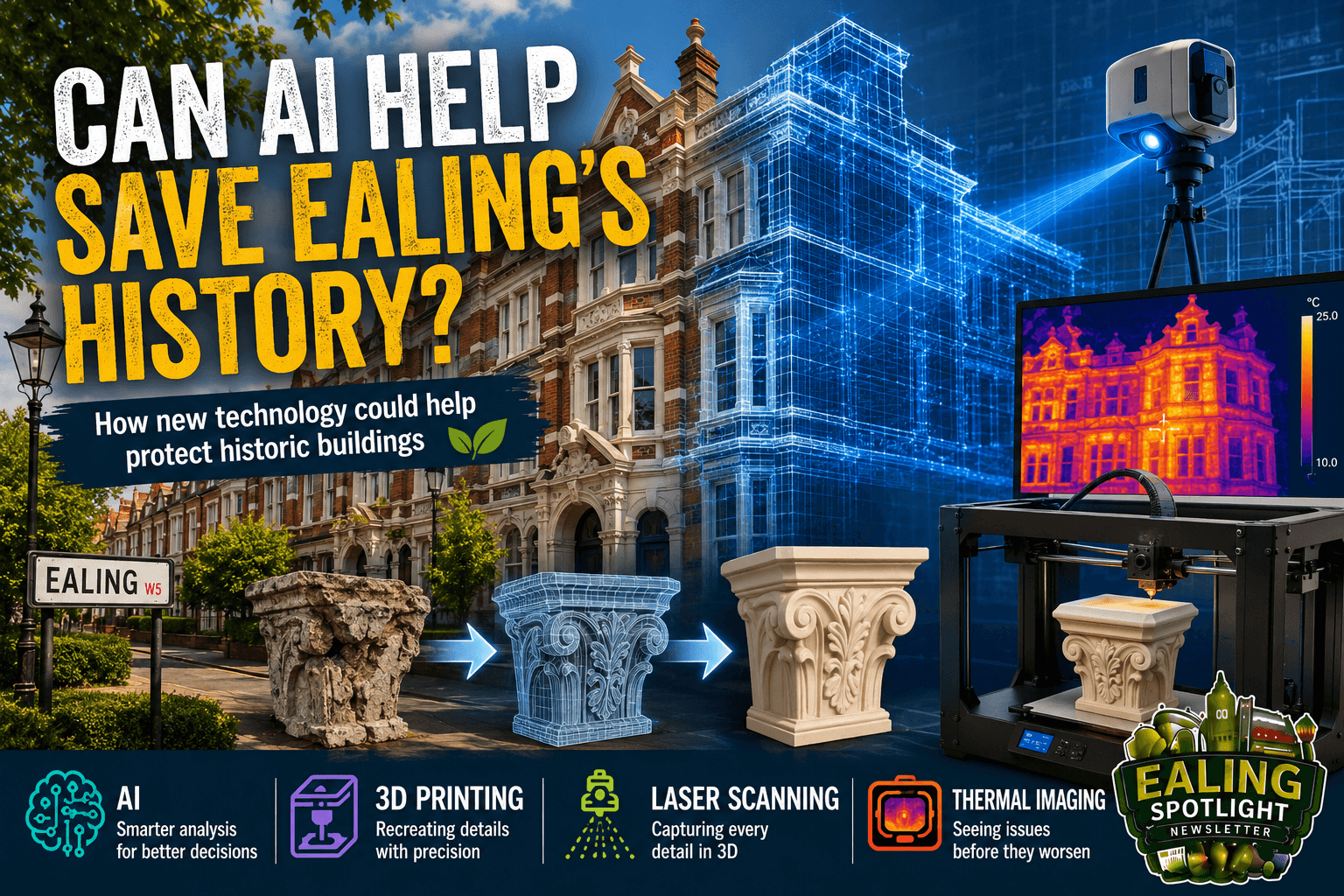
Ealing's historic buildings help give the borough its character, but maintaining ageing structures can be complicated and expensive.
Now increasingly sophisticated digital tools are giving conservation professionals new ways to understand buildings — sometimes without physically disturbing them. Walk around Ealing and its history is written into its buildings. Victorian and Edwardian homes, churches, civic buildings, conservation areas and locally significant architecture all contribute to the identity of different neighbourhoods across the borough.
But what if AI and 3D printing could help protect Ealing's historic buildings for future generations? That question has become increasingly relevant as technologies once associated mainly with engineering, manufacturing and computing find new applications in architectural conservation.
The subject was explored locally by Dr Efcharis Balodimou, a University of West London academic specialising in the built environment, during a presentation to Ealing Civic Society at OPEN Ealing in Dickens Yard. Her presentation examined technologies including artificial intelligence, 3D printing, laser scanning, thermal imaging and digital surveying and how they can complement traditional conservation techniques.
Creating a digital record of history.One of the most powerful developments is the ability to create extremely detailed digital records of historic structures. Laser scanning and digital surveying can capture the dimensions and physical characteristics of buildings with considerable precision. Instead of relying solely on conventional measurements, conservation teams can use this information to build detailed digital models. These records can then help professionals analyse structures, plan interventions and monitor how buildings change over time.
For heritage conservation, that has an obvious advantage. If a fragile architectural feature deteriorates years later, having an accurate digital record could provide conservation specialists with valuable information about its original form.
Finding problems without damaging the buildingSome of the technology is less about recreating what we can see and more about discovering what we can't. Thermal imaging, for example, can help identify temperature differences that may indicate problems such as heat loss or moisture. Other non-destructive surveying and remote-sensing techniques allow specialists to investigate historic structures while reducing the need for invasive examination. Dr Balodimou's research includes non-destructive testing, remote sensing and digital technologies for monitoring historic structures.
That can be particularly valuable when dealing with old or delicate materials. The objective isn't simply to discover damage after it becomes obvious. Better information could potentially allow conservation professionals to identify deterioration earlier and make more informed decisions about repairs.
Where does artificial intelligence fit in?Artificial intelligence adds another layer. Modern surveying can generate enormous amounts of information. AI-assisted systems can potentially help analyse that data, identify patterns and highlight areas that may require closer investigation.
But there's an important distinction. The technology isn't being presented as a replacement for architects, craftspeople or conservation specialists. Dr Balodimou's central message was that digital technologies and AI should complement human expertise rather than replace it.
That's especially important with historic buildings because conservation isn't simply an engineering problem. Decisions can involve architectural significance, craftsmanship, history, cultural value and judgement about what should — and shouldn't — be changed.
Could you 3D print part of a historic building?This is perhaps where the subject becomes particularly fascinating. 3D printing can potentially reproduce complex architectural components, offering conservation professionals another tool when replacement elements or models are required. The Ealing presentation highlighted 3D printing alongside other technologies being applied to conservation practice. Imagine an ornate architectural detail that has been badly damaged. A detailed digital scan could help record its geometry. Digital modelling could help reconstruct missing information. Modern fabrication techniques could then potentially assist in producing a replica or prototype. That doesn't mean pressing a button and printing an entire Victorian building. Traditional materials, specialist crafts and professional conservation judgement remain fundamental. The interesting development is how digital precision and traditional craftsmanship can increasingly work together.
Notre-Dame offers a glimpse of the futureOne international example discussed during the Ealing presentation was the restoration of Notre-Dame Cathedral in Paris following the devastating 2019 fire. The project demonstrated how sophisticated digital information and modern technology can work alongside traditional skills and craftsmanship when restoring an exceptionally important historic building. The scale may be very different from a historic building in Ealing, but the principle is relevant.
Technology doesn't have to compete with heritage. It can help us understand it. Why this matters in EalingEaling has substantial built heritage to protect. The borough's planning material describes more than 300 statutorily listed buildings and structures, six scheduled monuments, four registered parks and gardens and 28 conservation areas, alongside more than 700 non-designated assets on the local heritage register. That makes developments in conservation technology more than an abstract academic subject for the borough.
Ealing Civic Society has itself spent decades encouraging the preservation and improvement of Ealing's environment and historic features. As buildings age — and pressures around development, energy efficiency and sustainability increase — understanding existing structures becomes increasingly important. Digital surveys could create more detailed records. Thermal imaging could help identify hidden problems. AI could assist with analysing complex data. And technologies such as 3D printing could offer new possibilities for reproducing difficult architectural details. None eliminates the need for skilled people. Instead, the emerging model appears to be something considerably more interesting: centuries-old buildings, traditional craftsmanship and twenty-first-century technology working together. For a borough with as much architectural history as Ealing, that could become an increasingly important part of how the past survives into the future.
At a Glance
|
0 Comments
Join the conversation
Be the first to comment
Share your thoughts above.